The Buffer Is Running Out
The ceasefire rally bought a week of optimism. The blockade erased it in hours. And the emergency reserves keeping global oil markets functional expire in days.
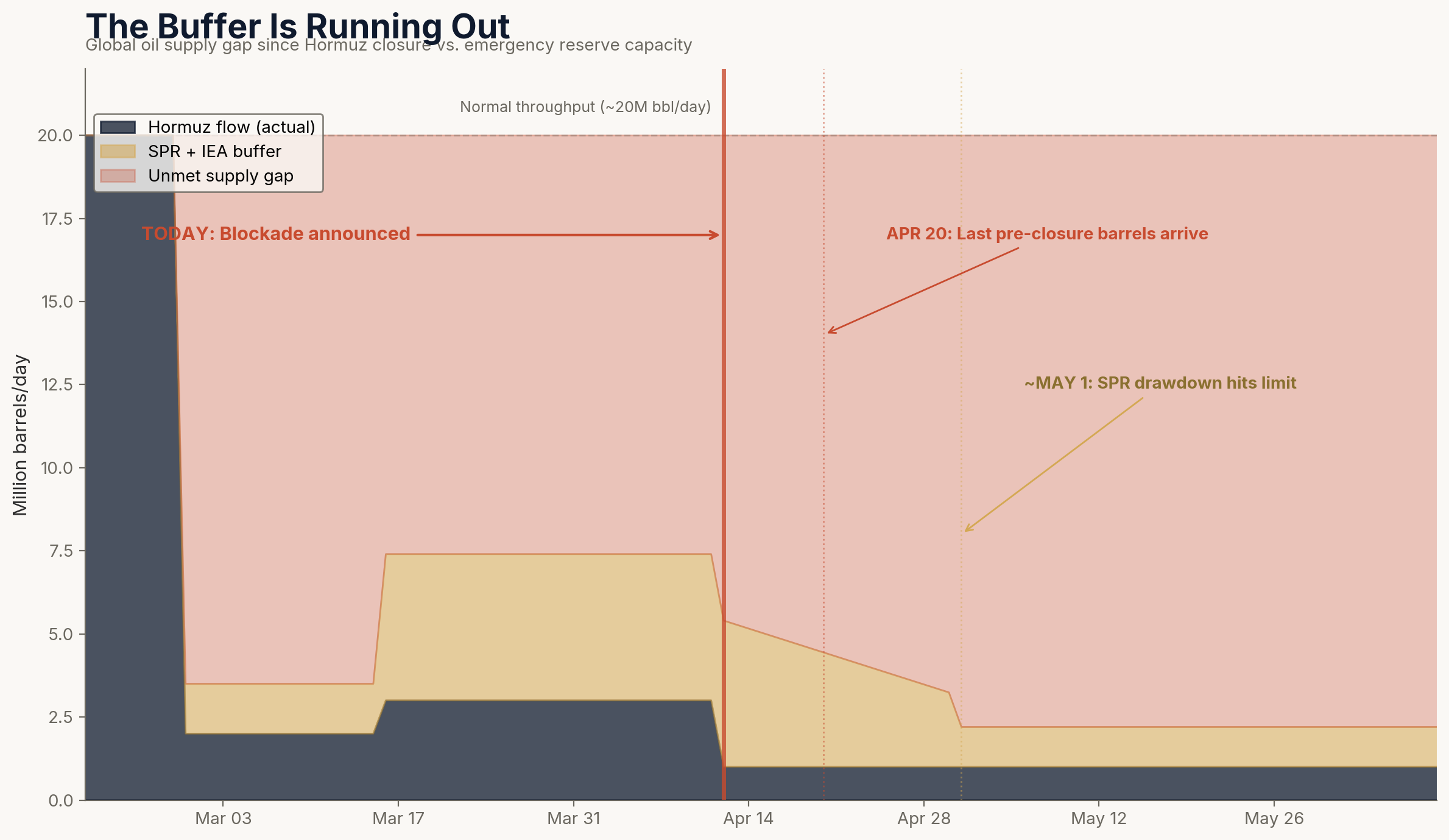
- 1April 20 is the date that matters. That is when JPMorgan estimates the last pre-closure tanker barrels reach their final destination. The 400 million barrel IEA emergency release is approaching its drawdown ceiling. When both buffers expire, the supply gap could widen from 5 million to 11 million barrels per day. The market is not ready for that math.
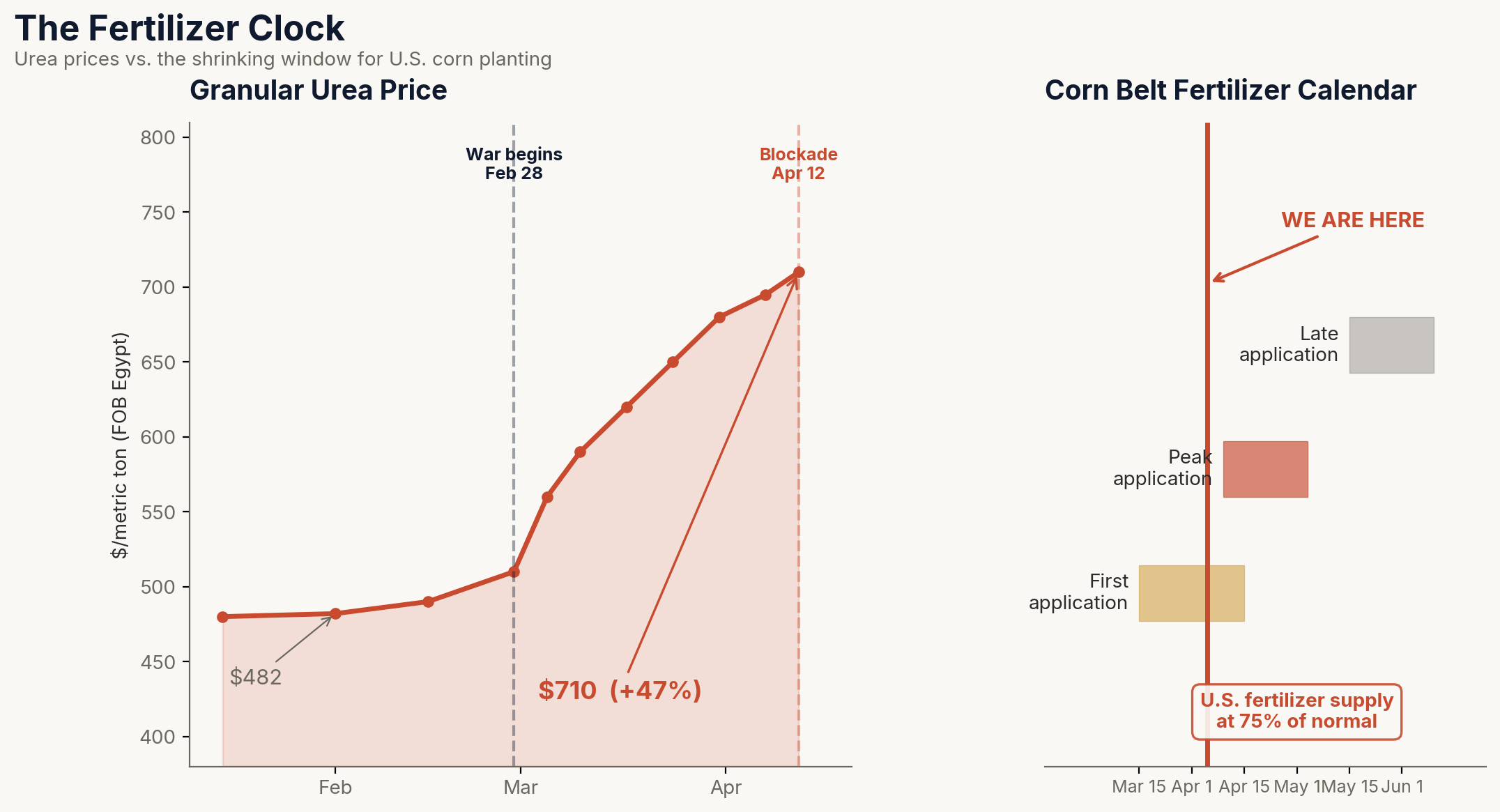
- 2Nobody is talking about fertilizer. A third of global seaborne urea trade runs through Hormuz. Prices are up 47% since the war started, U.S. supply is at 75% of normal, and Corn Belt farmers are entering peak application season this week. The food inflation that shows up in Q3 grocery bills is being locked in right now.
- 3The S&P rallied 3.6% last week on ceasefire hopes. Sunday night, Trump ordered a Hormuz blockade. WTI jumped 8% to $104, Dow futures dropped 500 points. Bank earnings start Monday. The collision of geopolitical escalation and earnings season has no recent precedent.
The Reserve Clock
April 20 is when the last tanker that cleared Hormuz before the closure is expected to deliver its cargo. After that date, every barrel the world consumes comes from reserves or alternative pipelines. The reserves are almost empty.
When Iran effectively closed the strait on February 28, the world leaned on two shock absorbers: strategic petroleum reserves and the barrels already in transit. Both are running out at the same time.
The IEA coordinated its largest emergency release in history on March 11: 400 million barrels across 32 member countries, with the U.S. contributing 172 million from the SPR at a maximum drawdown rate of 4.4 million barrels per day. But the supply gap has been running at 4.5 to 5 million barrels per day since the closure. The buffer was always just barely enough. With the blockade now removing Iran's own 1.85 million barrels per day in exports, the gap could blow out to 10 to 11 million barrels per day.
The SPR held about 415 million barrels before the drawdown began. After the 172 million barrel release, that leaves roughly 243 million, the lowest level since the early 1980s. The U.S. is burning through its emergency insurance at the exact moment the emergency is escalating.
The Blockade
After 21 hours of talks in Islamabad, Vance left Pakistan without a deal Sunday. Iran refused to give up its nuclear program. It demanded control of Hormuz, war reparations, and a broader regional ceasefire including Lebanon. Trump responded by ordering a naval blockade of all traffic to and from Iranian ports starting 10:00 AM ET Monday.
CENTCOM clarified that the blockade applies only to Iranian port traffic, not all strait transits. That distinction matters legally. It does not matter much for oil prices. WTI futures jumped 8% to $104 within hours. Brent hit $103. Heating oil spiked 10%.
The ceasefire optimism that powered last week's rally is gone. The S&P posted its best week since November on hope of a deal. Monday morning erases that bet.
The Food Shock Hiding In The Data
Oil gets the headline. Fertilizer gets the damage.
About a third of global seaborne fertilizer trade normally passes through Hormuz. The disruption has knocked out 33% of the global supply chain and halted roughly 22 million tons of annual urea exports from the Gulf. Urea prices have jumped from $482 per ton before the war to roughly $710. Nitrogen fertilizer production depends on natural gas, which has seen 70% price increases in some markets since the conflict began.
The timing is devastating. Mid April to early May is peak fertilizer application season for Corn Belt farmers. As of mid March, U.S. supply was at 75% of normal. The American Farm Bureau Federation warned that corn production is approaching a catastrophic moment with diesel above $5 per gallon. Farmers who cannot get urea in time will reduce corn acreage or switch to soybeans, which need less fertilizer. Either path means lower corn supply and higher food prices by Q3.
Russia has suspended ammonium nitrate exports. China has blocked phosphate shipments, pulling 25% of global supply. The UN World Food Program projects an additional 45 million people could face food insecurity by year end. None of this is in the equity market.
Meanwhile, Friday's CPI confirmed what the pump already told us: headline inflation surged 0.9% in March, driven by a 21.2% monthly gas price spike, the largest since 1967. Consumer sentiment cratered to 47.6, a record low since 1952. Year ahead inflation expectations jumped from 3.8% to 4.8% in a single month. The Fed is stuck between an inflation number it cannot cut into and an economy weakening beneath it.
What To Watch
April 20. That is the day pre-closure barrels are fully exhausted from the global supply chain. If the strait is not functionally reopened by then, the world transitions from "drawing down reserves" to "rationing supply."
Bank earnings, starting Monday with Goldman and running through Wednesday with Morgan Stanley and Bank of America. Listen for any language around tightening credit standards or accelerated loss provisions. If Dimon's Q1 commentary flags consumer credit deterioration under energy pressure, the recession debate goes from theoretical to priced in.
Corn planting reports over the next three weeks. USDA's first acreage estimates will reveal whether the fertilizer shortage translated into real production decisions. That data sets food prices for the rest of the year.
The agricultural clock does not care about diplomacy.